Showing posts with label Nomenclature Cards. Show all posts

Sunday, April 5, 2020

Montessori Botany - Seeds


MONTESSORI EARLY CHILDHOOD BOTANY - SEEDS STUDY PART I

Children simply adore the study of seeds.  Nothing speaks to energy and new growth quite like a seed and the potential life inside.  Sequoias Class has begun learning all about seeds even if it is long distance.  This post will take you through the sequence of seed presentations and works for the Early Childhood classroom.  Look forward to the second installment as our studies continue.

#1 SOAKING & DISSECTING BEANS
In the Montessori environment we always first introduce the real thing and then move to further abstraction of study.  In order to study seeds we will soak many large bean seeds in a bowl of water so we can explore them later.  It takes several hours, or even overnight for the beans to be ready.  When we are teaching in a classroom we don't want to soak too many or they will go to waste or start to really stink.  We try to soak only as many as we think will be used in a day.  Typically a child who takes this work from the shelf after a presentation will dissect 4-5 seeds on their own.

soaking beans in a sunny window

Once the outside (testa) of the seeds are supple and the seed is swollen they are ready to be dissected and explored.  The guide (teacher) will invite a student, or small group of children (no more than 3) to observe this presentation.

For this presentation you will need -A paper towel folded, tweezers, beans that have been soaking in a  small bowl until supple a tray to hold all the items, and a paper with parts of the beans glued as in the example photo:

Dissecting Seeds Presentation Tray

Dissecting Seeds Presentation
*Lay a vinyl mat or hand towel down on the table.
*Go to the shelf and retrieve the bowl of beans which have been soaking for several hours or overnight.
*Place the bowl of soaking beans at the top left corner of the table.
*Remove one seed and place on the mat.
*Say, "This is a seed.  This seed has been soaking in water for several hours.  I can see that this seed has gotten plump with water.  See how much bigger it is?"
*Point to the hilum of the seed and say, "This is the hilum of the seed.  It is where the bean was attached to the seed pod."
*Point to the micropyle of the seed and say, "This is the micropyle.  It is a small opening in the seed."


*Without speaking remove the testa (seed coat) very carefully from the bean.  Trying to keep it as intact as possible.
*Point to the testa and say, "This is the testa of the seed.  It is like a coat for the seed.  It helps to protect what is inside."
*Peel apart the two cotyledons of the bean seed being careful of the embryo inside.
*Point to the cotyledons and say, "These are called the cotyledons.  They will give the new plant the food it needs to grow."
* Point to the embryo still attached to the cotyledon and say, "This is the embryo of the seed.  It is the baby plant." (sometimes it is really helpful to have a red water soluble marker to mark the embryo with so the child can discern it from the rest of the plant)
*Carefully break off the radicle and say, "This is the radicle.  It will grow into the root of the plant."
* Carefully take off the epicotyl and say, "This is the epicotyl.  It will grow into the stems and leaves of the plant."
*For older and more advanced students who can write: Demonstrate creating a sheet with the parts of the seed glued and labeled.  It will take at least two seeds to create this work.
*Place the unused been seed parts into the compost.  Demonstrate how to clean up all of the pieces and return to the tray.  Then place the tray back on the shelf.
*Let the child(ren) know they may use this work whenever they choose now.  Ask if they would like to work with this work.


PARTS OF THE SEED PUZZLE

After the introduction to the actual seed and its parts the child can be introduced to the Parts of the Seed Puzzle.  I definitely have strong opinions about this work.  In many Early Childhood classrooms there is not a puzzle of the seed parts but it is ever so helpful and highly engaging for students.  There are many puzzle out there that seem like they would be more confusing than helpful to the student.  
I love this set of puzzles that details the entire growth process from seed to young plant.

Growing Process Parts of Puzzles
When a puzzle is not available there are other options such as this one made of felt.

PARTS OF THE SEED NOMENCLATURE CARDS

After the child has had some experience working with the puzzle (or if they choose not to use the puzzle but have experienced dissecting the seed) they are ready for the Nomenclature Cards for the Parts of the Seed.

When presenting this work begin by laying out the control cards only (picture and word card) and do a naming lesson.  This again goes over the vocabulary first introduced in the Dissecting the Seed presentation.  Once all the parts have been named you may take the Movable Alphabet to build the words.  Young children really do love to build the words.  You can find a printable Movable Alphabet here.

Once this presentation has been given you may, at a different time, formally present the Three-Part Card Lesson.  This video is a great explanation into how to give a Three-Part Card Lesson.
Seed Nomenclature Cards Laid Out with Booklet
Early Childhood Parts of the Seed Nomenclature Cards
click on image for link to file

PARTS OF THE SEED BOOKLETS

Booklets just might be THE absolute favorite paper work in the classrooms I have directed.  The children love to color them in and take them home.  Sometimes children want to skip the nomenclature card set and move straight into making the booklets.  I am careful to let them know they may do this work once they have worked with the nomenclature cards at least a few times.  After a while it becomes an understood boundary the children are happy to work with.
Early Childhood Parts of the Seed Booklet Blackline Master
click on image for link to file

GERMINATING A SEED

Children love to watch a seed germinate outside of the soil so they can really understand what is going on.  In this little experiment the child has the opportunity to set up their own seed germinating factory.  Use dicot seed if possible, such as a bean or pea for this work. 

All you need is a tray with plastic baggies, paper towels pre-cut to half size, bean or pea seeds, and tape. Children should get help to write their names on the baggie with a permanent marker.

Germinating a Seed Tray
Demonstrate WITHOUT SPEAKING how to create this work and put it on the window including writing the name.  After the presentation is finished you may say, "When you need to have your name put on your baggie please come and find me or the tonekeeper."  Once the seed(s) are in the baggie the child can tape them up on a sunny window and watch their seed germinate over the next several days.


DOCUMENTING SEED GERMINATION AND GROWTH

This work is especially helpful for more advanced students who can draw something that approximates reality.  That is often a second or third year student in the class.  There is no need to draw the picture every day, unless the child is self-directed in this.  Every few days is just fine.  The children are usually keen to keep track but often need a bit of a reminder of it as an option.

My Seed Growth Diary
Click on image for link to file


With Love,
Cath


Thursday, January 5, 2017

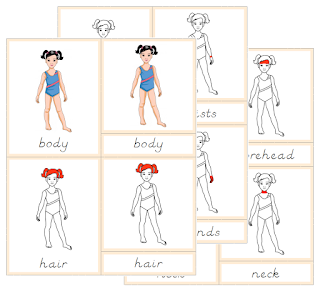
Parts of the Human Body

I was emailed by a reader that they had seen the parts of the body cards but it wasn't available online. I have so very many things I haven't uploaded yet that I can't remember which ones I do or do not have online.  I thank her for asking for them.

Here they are:

https://drive.google.com/open?id=0B-Jp2xvcHjp4UVhlLW9ra1pEdHM
Parts of the Human Body Nomenclature Cards
This is the companion Blackline Master for making the booklets:

Parts of the Human Body Blackline Master
 

Wednesday, November 5, 2014

Three-part Card Trays From Montessori Research and Development

I have made it no secret that I like many of the materials that are available through Montessori Research and Development.  This has always been purely because of many years of loving their work.  This is the first time I have ever gotten anything in exchange for a blog post, and I am so happy to do it.

If you have read some of my previous posts about Nomenclature or Three-part cards you will know that my classroom has had a big uptick in those cards being pulled off the shelves and used this year.  In fact it is almost certain that at any given time during the day there is at least one set of cards in use.  Since this is the case, I have felt it is in the best interest of the class to have more cards available in the areas at the same time.  I have owned and loved a few of the Three-part Card Trays from Montessori Research and Development for a some years, but really needed more.  I corresponded with Erik Nuno, who is the company director about hoping to get a few more for my classroom.  He shipped them right off and my class has been so happy to have them on the shelf ever since.  I currently have 9 on the shelves of my class.  3 in science, 2 in language, 1 in math, 2 in geography and 1 in sensorial.  Now that they have been set up for a couple of weeks I find that we actually could use a total of 5 in science (depending on what we are studying), 4 in math for currency, fractions, time, and golden beads (my colored bead stair cards are a different type).  I could also use a total of 5 in language for pink cvc cards, blue blends, parts of speech, the farm and metal inset cards, and 4 in geography regularly.  I would prefer to have 4 available for sensorial for sensorial apparatus cards, geometric cabinet cards, geometric solids cards, and color nomenclature cards.  I would lastly put one in art, not all the time but according to the lessons.  So that is a grand total of 23 that I would have in my classroom.  I am far from it, but will continue to order from Montessori Research until I have the number I want.


The Three-Part Card Tray from Montessori Research and Development is a economical and lovely tray for the classroom, running only $9.00 each.  The compartments are spacious enough to hold even larger cards, and certainly the cards that I create.  The depth of the compartments is a feature I like as well.  These are both something you want to watch for when ordering trays.  They are easily cleaned by even smaller children, with the control of error being a gleaming white surface.


The other tray that I looked at in the same price range had the control on the right.  That went against my core feelings when it comes to Montessori works.  I have always been taught, and ascribe to the standard that all work should move left to right.  Since we place the control first it should be on the left hand side.

I am so happy to recommend the 3-part Card Tray from Montessori Research and Development.

Monday, November 3, 2014

Parts of the Eye Nomenclature Cards and Blackline Master Free Downloads - Plus a Musings About the Sense of Sight

I created this set over the summer for our class to use while we learned about the sense of sight.  This year I have changed from doing all the senses at once to focusing on on sense in a month.  All of the senses were introduced during the 3rd week of school, but taking each sense and focusing more in depth has been rather enjoyable for the children this year.  The sense of sight was the first sense of focus.

To begin the sense of sight we took a little walk out to our community garden with a bit of prompting to pay close attention to interesting things that we could see there.  Once back inside we had a discussion about all the things they could see.  This took some time since all the children wanted to talk about more than one thing that was interesting to them that they could see.  The next question was, of course, "What part of our body do we use to see?".  At a later circle I introduced the Model of the Eye.  I have long been of the opinion that the Early Childhood through the Upper Elementary Child can benefit greatly from good quality medical models just as much as the college student.  While I would love to have inexhaustible pockets, I do not, so I purchase the best quality I can for my budget.

This model is from EISCO and was purchased from Amazon using our Prime Membership.  It ran just about $25.00.

After the children were introduced to and had some experience with the model, I introduced them to some sheep eyes and did a dissection.  Now-- I must say that there was NOT one child who was grossed out by this science work.  Quite the contrary.  Utter fascination and riveted attention is more like it.  I used these Large Line Time Cards to point out different the same parts we were seeing in the sheep's eyes.

Parts of the Eye Large Line Time Cards
click on picture to link to file


On a different day I introduced the Parts of the Eye Nomenclature Cards and the accompanying booklets.  Especially the 4's & 5's loved this work.  There were some children who loved them so well, they took them off the shelf EVERY day for two weeks.
Parts of the Eye Nomenclature Cards
click on image to link to file

Parts of the Eye Blackline Master
click on image to link to file
  

Saturday, October 11, 2014

Parts of the Skeleton and Parts of the Pumpkin Nomenclature Cards with Blackline Masters

Here are two offerings that I have finished in these last couple of weeks.  These are topics we are studying right now during October and I found I didn't have either of them created yet.

An important note is that the skeleton cards are patterned after a 3-4 year old's skeleton.  I adapted them from this printable work.

I didn't like any of the Parts of the Pumpkin cards that are out there.  You might notice the same type of cutaway as the layers of the earth.

Parts of the Skeleton Nomenclature Cards
click on image to go to file


These are the blackline Masters for both sets.  I have been learning a new way to make and use Parts of Books that I really like.  The first page in the blackline masters are just the image with no words or even a line.  The following pages are to help me in making the Parts of Control Books.  First I color in the isolated image in red and then I trace over the light gray letters with a fine sharpie pen.   I cut them apart, laminate them and plasticoil bind them.  I make sure that the plasticoil gives plenty of room for turning the page with ease.


One thing I learned years back is that whatever way you write your letters the children will copy.  Another thing I learned during one of my Practicum weekends was that a segment of the population cannot make sense of dotted or dashed letters.  Each dot looks separate and does not really create a whole letter.  This was troubling news to me and I started wondering about my oldest child with dyslexia.  Did that make things harder for her?

When the child creates the parts of books they can do one of 3 things in order to write the words.  They can copy the words because they are advanced enough to do that.  They can lay their colored parts of paper over the top of the page they are trying to create and trace over the letters, or I can write the words in a yellow highlighter for them to trace.  All three methods are regularly being employed in my classroom with great success.

Parts of the Skeleton Booklets Blackline Master
click on image to go to file


Parts of the Pumpkin Booklets Blackline Master
click on image to go to file


Wednesday, October 1, 2014

Nomenclature Cards and Parts Booklets - What a Little Child Taught Me

I have formed a new friendship with the Nomenclature and 3-Part Cards and their subsequent Parts of Booklets this year.  Last year a few of the children really loved doing the cards and the booklets, while most of others have shown no real interest in them.  This year I have been hoping to interest more children in these lovely little cards and booklets that I have spent so much time creating (literally), laminating, cutting, coloring, binding etc.  They are great works that help integrate learning across the areas of the classroom.  They can be a pre-reading, reading, writing, coloring, story-telling, show-off to parents, memory building, science, geography, math, sensorial work.  You might be getting the picture.

WELL... this year our class has had the most wonderful thing happen, AND it was child directed.  About the third week into school I had a 4 1/2 year old, who is driven by a lovely inner voice, do the Parts of the Plant and Parts of the Fruit Nomenclature Cards at the same time.  He then made the Parts of Booklets as well.  Another child saw his work and wanted to do it too.  Both were very accomplished at their work.  At the end of the day they asked if they could read their books to the class in AUTHOR'S CHAIR (they knew this from last year and Writer's Workshop).  Of course I let them, and everyone clapped for their wonderful and challenging work.  I could have chosen to save the Author's chair for books that the children had independently created, but I am so glad I didn't.  We will make an extra special note when a child makes a book All-By-Themselves for Author's Chair.

The magic happened the next day.  Multiple children asked me if they could create their own books in order to read them to the class.  One child said... "So when I finish the Nomenclature Cards I can make a booklet right?"  I said that once she had mastered the nomenclature cards she could create the booklet.  The children spread the word and the Nomenclature Cards have NOT sat on the shelf gathering dust (that a child would clean off) this year.  The valuable lesson the children taught me is this: There is such beauty in sharing your work with your friends, and such a good feeling.  As an adult I recognize this in myself.  It is one reason I have this blog.  I love to share what I have created with people who appreciate and can really use them.  Why would it be any different for children?

I just have to say... Follow the Child, they are our best teacher.

Solar System Nomenclature Cards
This is the same child doing the Nomenclature Cards and the Parts of Book in the next Picture.


Solar System Parts of Cards
This Parts of Booklet is pre-stapled because last year I noticed how frustrated the children were 
about this booklet.  They kept getting confused which planet was which.  I have some unstapled 
sets for the older kids.
Parts of the Body Nomenclature Cards
This child ended up getting one more rug out to hold all the name cards you can see at the top 
of the picture for this work.  There really are a lot of cards to this work.  Almost enough to break it 
into two sets, but they really like it together so I have kept them that way.  The Tray is from 
Montessori Research and Development.


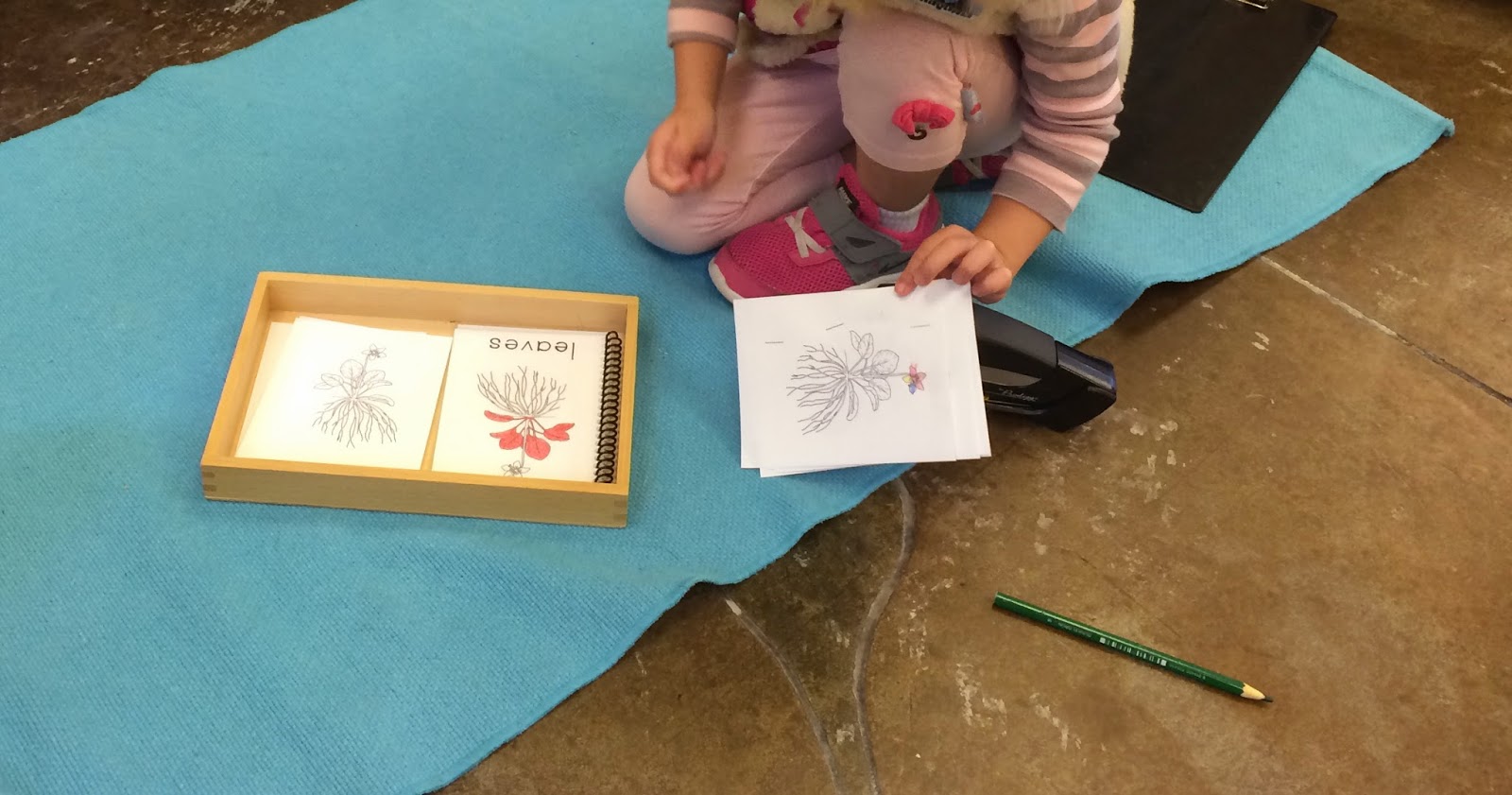
Parts of the Plant Booklet
This child did not want to write the words to her booklet this day.  I let her know that as 
soon as she "publishes" a book - meaning that it is colored, with all the names written and 
stapled - she can read it to the group.


Saturday, September 13, 2014

Taking Over a New Class

This year I have changed classrooms and responsibilities.  I moved from my safe little classroom to take over for some teachers who left our school.  It is my job to make this classroom successful.  I am in the Spanish dual language program classroom now.  It is a mixture of children from several classrooms, but there is a core group of children who were there last year.  These children have really needed retraining this year.  About 80% of them are boys.  I have spent a lot of time during the first 3 weeks of school observing all of the children, becoming emotionally available and a confidant, creating structure in the classroom, following through again and again with ground rules, and setting the stage for correct treatment of the environment and each other.  It is tiring work to be sure, but sticking to the difficult work at the beginning of the year really pays off.

For the first two weeks I pulled out over 25 different manipulative works and had several shelves dedicated to them just to give myself a pulse on the room and where the children were.  They used these works with gusto.  It has really helped to have only manipulatives in retraining the children to become careful with their work, return the work ready for another child to use, walk around and not through rugs, walk in the classroom in the first place, respect when a child has already chosen a work and not to disturb them etc.  This is certainly an ongoing process.  It seems like it can take an entire year for some of the younger children not to walk on their neighbor's rug if something grabs their attention.

During the third week I noticed that the older children were bored with the manipulatives so I began giving lessons.  Some of the record keeping was spotty so I had to test out to see where they really were in the different areas.  On Thursday, this week (being the 4th week of school), we noticed that it was 2 hours into our work time before any child chose a manipulative work.  YIPEE!  I only have one shelf of manipulatives now, and only the ones that the children find the most interesting.

These are some images from our last week of work.

Exploration of Metal Insets by a returning student


Mouse House turned into a Spanish Work.  Es el raton debajo de la casa anaranjado?

Hanging Bead Stair

Writing Words using the Large Moveable Alphabet

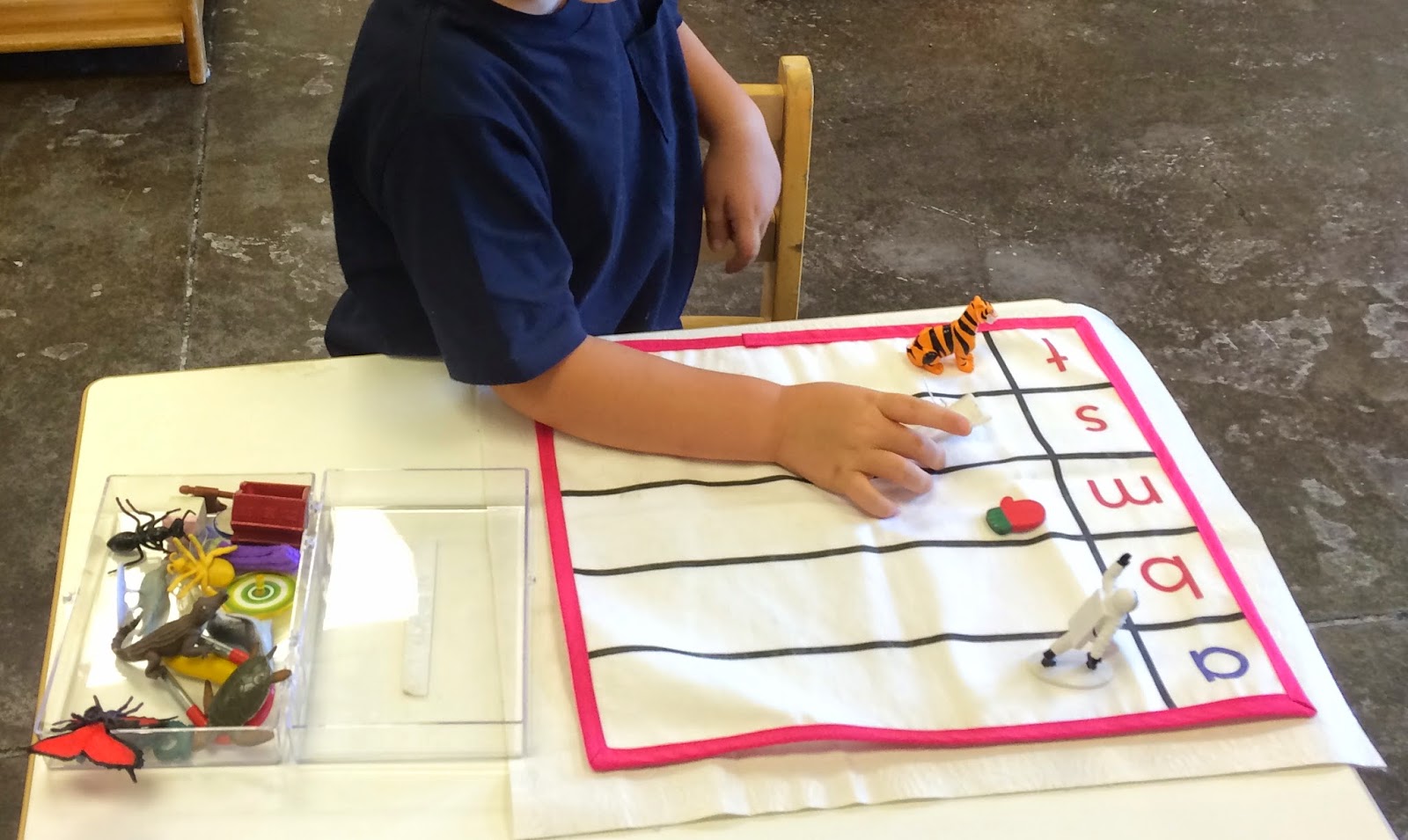
Initial Sound Object Sort - This is the Pink Mat
I am so excited to have these new mats.  I handmade the set I
have been using and just got these new ones this week.

Gluing noodles on apples work.  Next week we will paint these works.
This allows the work to be done in more than one step but still follow
the Montessori rule that art should be a shelf work.

Parts of the Plant Nomenclature Cards.  This child completed this work
 beautifully and could even tell me every part of the plant and later the
Fruit.  He then made the booklets for each work.

Rainbow Rings.  My children LOVE this work.  It is actually
Wine Glass Markers that I found at a kitchen store in Park City.

Using Clay Lesson.  You can see how the little one is using
his "watching arms" during this presentation.

Parts of the Snail Puzzle.  We wouldn't usually have this work
out right now, but this child found a snail in the school
garden and was really interested so I pulled it out.

Weaving with ribbons

Parts of the Flower Puzzle

Parts of the Fruit Nomenclature Cards and Magnetic Parts Puzzle 
Baby Spooning Stars.  This work is pretty challenging for this child.
She has been with me since last year and has needed this long to
be ready for this work.

Sandpaper Letters with Initial Sound Booklets.
This child was successful at all the letters in the first
set and was subsequently hiding them in the
classroom to then find them again.

Hand Transferring.  I just have to say how much I love the
elliptical shape of these wooden bowls.  There are mung beans
inside.  They sound just like rain when they hit the
wood.  Many times the child will remark about this when
they first have this lesson.

Object to Object Sorting with two Space Toobs.  Because I
have so many boys I have geared some of the Pre-reading
works to pull them in.  We are also beginning the year by
learning about our place in the universe.
The Farm Mat - a grammar work.  I made this mat as well.

Sunday, November 3, 2013

Montessori Botany Primary Parts of Cards - Update!!!

During my new training this summer I learned so much, and have had to adjust my thinking and approach in some ways as I have been stretched.  I am so grateful to have had this opportunity to become a better educator and guide for my children.

As a result of the training I have learned more about the Parts of Cards.  My lovely and VERY knowledgable queen of a trainer, Teresa, spoke about why it is important for primary Montessori classes (3-6 years) to have the isolation of the difficulty in red.  First, our eyes are drawn to red.  This was, of course, not new information for me.  But more importantly, when a child is making their own parts of booklets and they have to keep changing pencils to color, let's say, the horse's legs in dark brown, off white, and light brown for the hooves... the child is actually paying more attention to the COLORS instead of the part they are learning about.  We also discussed which parts are appropriate to focus on for the primary class as opposed to the elementary class.  They should be more simple.  For example, when making Parts of Cards for the fish we will show all the fins together and call them just fins instead of separating them as the caudal fin, pelvic fin, pectoral fin and so forth.

The light bulb went off in my head, I understood it in my heart, and then I groaned within myself.  I knew that all the parts of cards that I have been making and posting on this blog have been geared toward ELEMENTARY and not primary!!  I also knew that I would need to remake my cards for the children's sake.  It took me a couple of weeks to really get my soul prepared... and then I went to work.

part of the fruit of my efforts are in this post.  I am actually excited now to make more.  I have been wanting to make parts of cards for tools, the house, and other things like cars, planes and trains that some of my students are fascinated with.

You will note that Botany and Zoology cards have a colored line around them.  I have considered this idea for a long time, but wasn't sure how I really felt about it.  Now I am ready to roll with it.  Another thing to note is that I have done these cards in D'nealian only.  I will not lie that it is my preferred font for parts of and nomenclature cards and I am not ready to do the print font yet.

This is a living and changing experience for me and it follows as the night the day that my blog will also change.

Botany Parts of Cards


Primary Parts of the Plant Cards - red isolation
click on picture to link to file
Primary Parts of the Tree Cards - red isolation
click on picture to link to file
Primary Parts of the Leaf Cards - red isolation
click on picture to link to file
Primary Parts of the Flower Cards - red isolation
click on picture to link to file
Primary Parts of the Fruit Cards - red isolation
click on picture to link to file
Primary Parts of the Seed Cards - red isolation
click on picture to link to file